:
:

Case Study: Exactly How to Use Kojic Acid for Dark Spots (Real Results)
Let’s be blunt: most of the advice you read online about fading dark spots is either flat-out wrong or dangerously incomplete. You see these incredible before-and-afters, buy a hyped-up product, and then… nothing. Or worse, your skin gets irritated and the spots look even darker. It’s a frustrating cycle, and after 15 years in this industry, I’ve seen it play out hundreds of time. The truth is, there’s no single “magic eraser” for hyperpigmentation. But there is a science to it, and when you combine the right ingredients with the right routine, the results can be genuinely transformative. This case study breaks down exactly how to use kojic acid for dark spots, paired with its powerhouse partner, alpha arbutin, to achieve real, lasting clarity.

We’re going to follow the journey of a real client—let’s call her Maya—who came to us with persistent post-acne marks and sun spots. Her story isn’t unique, but her results are a testament to what’s possible when you stop chasing trends and start building a smart, consistent protocol. Forget the fluff; this is a no-nonsense look at what actually works.
First, What Are We Actually Fighting? Understanding Hyperpigmentation
Before we dive into the solution, you have to understand the problem. Dark spots, whether they’re from the sun (sun spots), old blemishes (post-inflammatory hyperpigmentation or PIH), or hormonal changes (melasma), all have one thing in common: an overproduction of melanin. Melanin is the pigment that gives your skin, hair, and eyes their color.
Think of your skin cells (melanocytes) as tiny pigment factories. An enzyme called tyrosinase is the factory manager. When your skin is exposed to a trigger—like UV radiation from the sun or inflammation from an acne breakout—the tyrosinase manager goes into overdrive, telling the factory to produce way more melanin than usual. This extra melanin clumps together and gets deposited in the upper layers of your skin, forming a visible dark spot.
The goal of any effective brightening treatment isn’t to “bleach” the skin. It’s to interrupt this process. You need ingredients that can tell that overactive factory manager to calm down and regulate production. That’s precisely where our two heroes come in.
The Dynamic Duo: Why Kojic Acid and Alpha Arbutin Are a Dream Team
You can use these ingredients separately, but I’ve found that they work exponentially better together. They tackle the pigmentation pathway from two slightly different angles, creating a more comprehensive and effective approach.
Kojic Acid: The Tyrosinase Inhibitor
Derived from fungi during the fermentation process of certain foods like sake and soy sauce, kojic acid for skin is a true powerhouse. Its primary job is to act as a chelating agent, which means it essentially binds to the copper ions that the tyrosinase enzyme needs to function. No copper, no overactive enzyme. It directly puts the brakes on that runaway melanin production.
- What it does: Effectively blocks the enzyme responsible for creating excess pigment.
- Best for: Stubborn sun spots and post-inflammatory hyperpigmentation.
- The catch: Kojic acid can be slightly unstable and may cause sensitivity in some skin types if not formulated correctly or used too aggressively. That’s why formulation and starting slow are key.
Alpha Arbutin: The Safer, Stable Regulator
If kojic acid is the emergency brake, alpha arbutin for dark spots is the sophisticated cruise control system. It’s a naturally occurring derivative of hydroquinone (the long-time prescription gold standard) but without the associated risks and potential for irritation. Alpha Arbutin works by slowly releasing its active component, which inhibits tyrosinase activity without killing the melanocyte cells themselves.
- What it does: Gradually slows down melanin production at the source for a more controlled, even-toned result.
- Why it pairs well: It’s incredibly stable and gentle, making it the perfect partner to buffer the more potent effects of kojic acid. It provides a steady, background level of pigment control.
- The result: You get the potent, spot-fading power of kojic acid and the gentle, overall brightening effect of alpha arbutin. It’s a combination that delivers results with a much lower risk of irritation.
The Case of Maya: A 12-Week Protocol for Fading Dark Spots
Maya, a 34-year-old with combination skin, came to us frustrated. She had a cluster of sun spots on her left cheekbone and a smattering of reddish-brown marks on her chin from a recent hormonal breakout. She’d tried vitamin C serums and aggressive scrubs with little success. Here’s the exact protocol we created for her using a serum for pigmentation that contained both kojic acid and alpha arbutin.
Weeks 1-4: Building the Foundation (Patience is Everything)
This phase is the most critical and, honestly, the one where most people give up. You won’t see dramatic results yet. The focus here is on consistency and acclimatization.
- Patch Test: Before anything, Maya patch-tested the serum on her inner arm for 24 hours, then behind her ear for another 24. No reaction. This is a non-negotiable step.
- Introduction Phase: She started by using the {{internal_link:Aval Naturals Brightening C-Complex Serum}} (which contains both ingredients) only once every other night. This allowed her skin to get used to the active ingredients without being overwhelmed.
- The Rest of the Routine: Her routine was simple and supportive. A gentle cleanser, a hydrating toner, the treatment serum, a simple moisturizer. Nothing else. No other exfoliants or actives.
- SUNSCREEN: This is the most important part. She committed to using a broad-spectrum SPF 30+ every single morning, rain or shine. Using tyrosinase inhibitors without protecting your skin from UV is like trying to mop up a flood while a fire hose is still running. It’s pointless.
End of Month 1 Observation: Maya reported no irritation. The spots hadn’t faded much, but she noticed her overall skin tone looked a little brighter and less sallow. This is a great sign.
Weeks 5-8: Hitting the Stride and Seeing the Shift
With her skin fully adjusted, we ramped things up slightly. Since she had no sensitivity, Maya increased the serum application to once every night.
This is when the magic starts to happen. The consistent application of kojic acid and alpha arbutin has had enough time to significantly slow down the pigment factories. At the same time, her skin’s natural cell turnover process has been bringing the older, over-pigmented cells to the surface and shedding them.
Expert Tip: Around week 6, we had Maya add a gentle chemical exfoliant (like a lactic acid toner) into her routine twice a week, on nights she wasn’t using the brightening serum. This helped speed up the shedding of those darkened surface cells, revealing the clearer skin underneath more quickly.
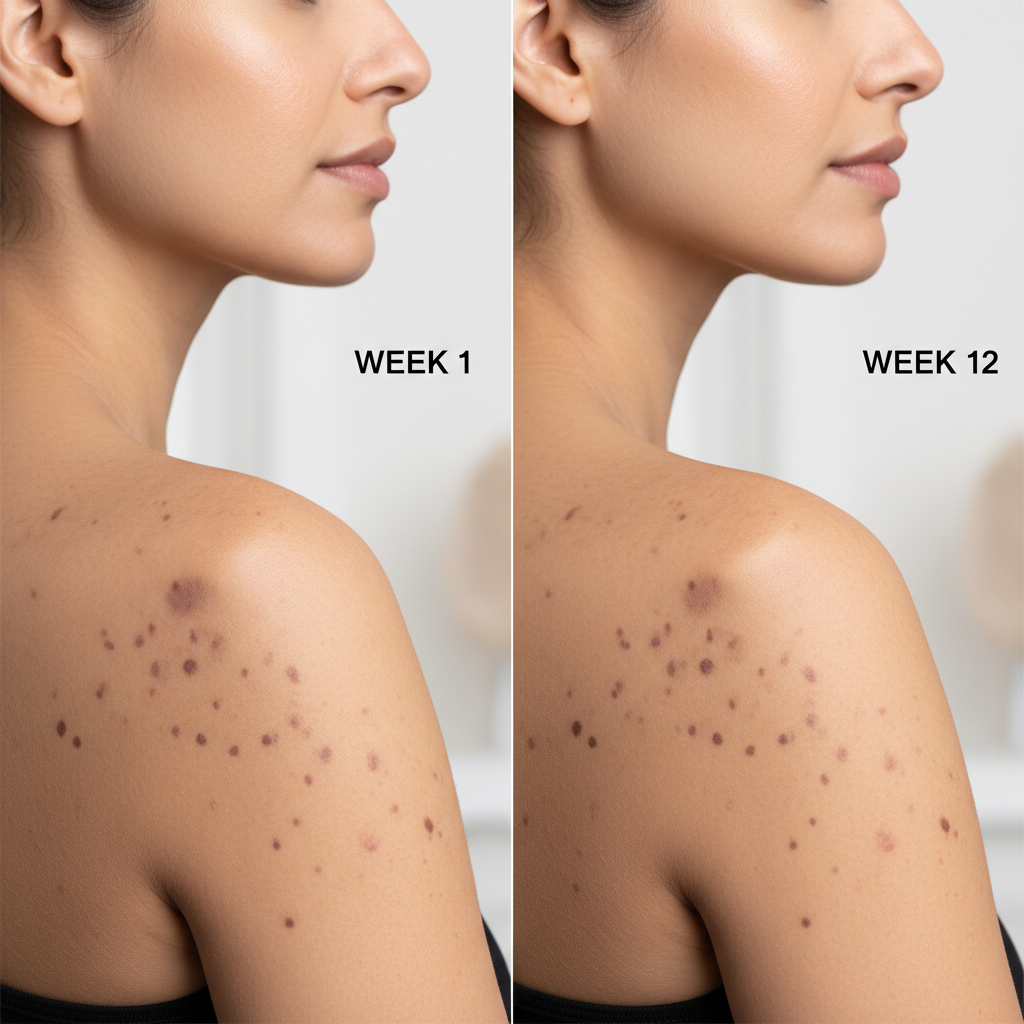
End of Month 2 Observation: This is when Maya got excited. The post-acne marks on her chin were visibly lighter, almost blending into her skin. The sunspot cluster on her cheek was still there, but it looked less defined and more “broken up.”
Weeks 9-12: The Payoff and a Maintenance Mindset
In the final month, Maya continued with her nightly serum application and twice-weekly exfoliation. The routine was now second nature. The key here was unwavering consistency.
By the end of the 12th week, the results were undeniable. The post-acne marks were virtually gone. The sunspot cluster, the most stubborn of the bunch, had faded by an estimated 60-70%. It was no longer the first thing you noticed on her face. Her entire complexion was luminous and remarkably even.
What’s next? Maintenance. She now uses the {{internal_link:serum for pigmentation}} 3-4 nights a week to keep pigment production in check, and she remains absolutely militant about her daily sunscreen. That’s how you protect your investment.
What We See in Practice: A Realistic Guide on How to Use Kojic Acid for Dark Spots
As a professional, I see people make the same mistakes over and over. Here’s my real-world advice, distilled from years of client consultations.
“The biggest mistake is impatience. People expect a serum to work like a laser. They use it for two weeks, see nothing, and quit. Or they get aggressive, use it twice a day from the get-go, irritate their skin barrier, and trigger more inflammation and pigmentation. Slow and steady truly wins this race.”
- Start Low and Go Slow: I can’t say this enough. Every other night for at least 2-4 weeks. Your skin needs time to adapt.
- Sunscreen Isn’t Optional: I’ve mentioned it three times because it’s that important. Using these ingredients makes your skin more sensitive to the sun. Not using SPF is counterproductive and will make your spots darker. Read more on our guide to {{internal_link:choosing the right SPF}}.
- Listen to Your Skin: If you feel stinging, burning, or see excessive redness or peeling, back off. Stop all actives for a few days and focus on hydration. Then, reintroduce the serum even more slowly (e.g., once every three nights).
- Combine with Supportive Ingredients: Look for formulas that also include antioxidants like Vitamin C and hydrators like hyaluronic acid. These create a healthier overall skin environment, which helps the actives work better.
The Expert Framework: Layering Skin Brightening Products Correctly
How you apply your products is just as important as what you’re applying. Applying a serum on top of a heavy cream, for example, is a waste of money because it won’t penetrate. Follow this order for maximum efficacy.
- Step 1: Cleanse. Start with a clean canvas. Use a gentle, pH-balanced cleanser to remove dirt, oil, and makeup without stripping the skin.
- Step 2: Tone (Optional). If you use a hydrating toner, apply it now on damp skin. Avoid astringent or alcohol-based toners.
- Step 3: The Treatment Serum. This is the most important step. Apply a pea-sized amount of your Kojic Acid/Alpha Arbutin serum to your entire face, or just to the affected areas if you are particularly sensitive. Pat it in gently. Wait a full 60 seconds for it to absorb.
- Step 4: Moisturize. Apply a simple, nourishing moisturizer to lock in the serum and support your skin barrier. Barrier health is paramount when using active ingredients.
- Step 5: Sunscreen (AM Only). The final, non-negotiable morning step. Apply a generous amount of broad-spectrum SPF 30 or higher.
By following this simple, repeatable framework, you ensure that the powerful active ingredients in your serum can do their job without interference. Consistency with this routine is what will deliver results like Maya’s.
Fading dark spots is a marathon, not a sprint. But with the right strategy, the right ingredients, and a healthy dose of patience, achieving a brighter, more even-toned complexion is absolutely within your reach. Maya’s 12-week journey is proof that understanding the science and respecting your skin is the true secret to success.
Frequently Asked Questions
From an SEO execution perspective, improving how to use kojic acid for dark spots is usually where we see the strongest compounding gains over 3-6 months.
From an SEO execution perspective, improving how to use kojic acid for dark spots is usually where we see the strongest compounding gains over 3-6 months.
From an SEO execution perspective, improving how to use kojic acid for dark spots is usually where we see the strongest compounding gains over 3-6 months.
Frequently Asked Questions
Can I use kojic acid and alpha arbutin every day?
Yes, once your skin is acclimatized. Start by using a serum with these ingredients every other night for 2-4 weeks. If you experience no irritation, you can increase to nightly use for best results.
How long does it take for kojic acid to fade dark spots?
Be patient. While some initial brightening can be seen in 4 weeks, significant fading of dark spots typically takes 8-12 weeks of consistent use. Results depend on the darkness and age of the spot.
What should I not mix with kojic acid?
Avoid using other potent actives like retinoids, benzoyl peroxide, or high-concentration AHA/BHAs in the same routine (i.e., at the same time of day). You can alternate them on different nights to minimize the risk of irritation.
Is Alpha Arbutin better than Vitamin C for pigmentation?
They work differently. Alpha Arbutin is a more direct tyrosinase inhibitor, making it highly effective for stubborn spots. Vitamin C is a great antioxidant that also helps with brightening and provides other skin benefits. Many modern serums, including ours, combine them for a multi-pathway approach.
Do I have to wear sunscreen when using these ingredients?
Absolutely, yes. It is non-negotiable. Kojic acid and alpha arbutin can make your skin more photosensitive. Without daily broad-spectrum SPF 30+, you risk making your dark spots even worse.
Can kojic acid permanently remove dark spots?
It can significantly fade or even remove existing spots, but it doesn’t prevent new ones from forming. If you get new sun exposure or inflammation, new spots can appear. Maintenance with the serum and consistent sunscreen use is key to keeping skin clear.